To no surprise, and already confirmed by J.K. Rowling, the big battle to come in the
Fantastic Beasts films will be that of Dumbledore and Grindelwald's duel in 1945, which will presumably cap off in the fifth and final installment of the series.
Several questions have arisen as to how much interaction the two will have before the final duel, and how big of a role Dumbledore's sexuality will play in subsequent movies. The
brief synopsis for
Fantastic Beasts 2, released on Monday, states the following about Dumbledore's involvement:
Quote:
The only one who might be able to stop [Grindelwald] is the wizard he once called his dearest friend, Albus Dumbledore. But Dumbledore will need help from the wizard who had thwarted Grindelwald once before, his former student Newt Scamander.

Three other pieces of information about Dumbledore in the second movie are known so far: Oscar-nominee Jude Law will portray him in the film series; Dumbledore's in his early 40s and Transfiguration teacher at Hogwarts at the time of the movie; and Dumbledore is "very mischievous and enormous fun and a bit of a political animal,"
according to director David Yates, who read an early draft of the sequel script last year as Rowling was writing it.
So where does Dumbledore's sexuality, and in tandem, his relationship with Grindelwald play into the series (if at all)?
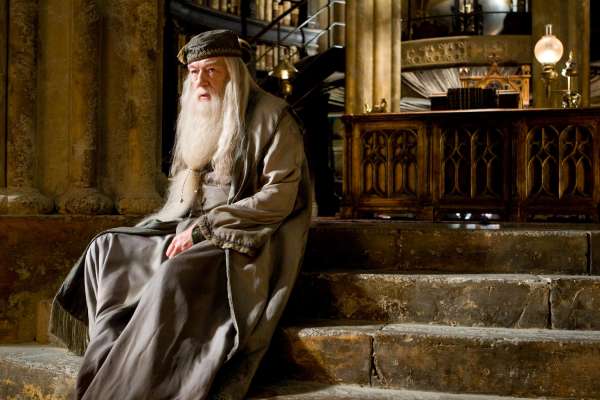
Soon after the publication of
Harry Potter and the Deathly Hallows in 2007, Rowling confirmed that Dumbledore was gay, and was infatuated with Grindelwald as a teenager. The author
noted that it was not a true friendship, and more of a one-sided manipulative relationship where Grindelwald took advantage of Dumbledore's fascination with him to lure him into his 'Greater Good' ways of giving the wizarding community control over the Muggle/No-maj one.
Quote:
J.K. Rowling: "Has Dumbledore ever been in love?" So I was absolutely honest about how I saw the character: I always imagined that Dumbledore was gay. How relevant is that to the books? Well, it's only relevant if you considered that his feelings for Grindelwald, as revealed in the 7th book, were an infatuation rather than a straight-forward friendship. That's how I think -- In fact, I know that some, perhaps sensitive, adult readers had already seen that. I don't think that came as a big surprise to some adult readers. I think a child would see a friendship, and a very devoted friendship. But these things also occur.
So I -- How relevant is it? Well to me, it was only relevant in as much as Dumbledore, who was the great defender of Love, and who sincerely believed that Love was the greatest, most powerful, force in the universe, was himself made a fool of by Love. That to me was the interesting point. That in his youth, he was-- he became infatuated with a man who was almost his dark twin. He was as brilliant, he was morally bankrupt, and Dumbledore lost his moral compass. He wanted to believe that Grindelwald was what he wanted him to be, which is what I think, particularly, a young person's love tends to do.

Rowling here gave a keen understanding of the two's relationship, and that Dumbledore was so destroyed by the manipulative relationship that he essentially shut himself down romantically for the rest of his life, after his summer with Grindelwald, as the author
stated in 2008:
Quote:
J.K. Rowling: The issue is love. It’s not about sex. So that’s what I knew about Dumbledore. And it’s relevant only in so much as he fell in love and was made an utter fool of by love. He lost his moral compass completely when he fell in love and I think subsequently became very mistrusting of his own judgment in those matters so became quite asexual. He led a celibate and bookish life.
It seems that Dumbledore's sexuality won't make much of a difference, even with his former relationship with Grindelwald, going forward in the next
Fantastic Beasts movies.
There are also two pieces of information revealed about Grindelwald and Dumbledore in
Deathly Hallows; however as they came from Rita Skeeter, their authenticity leaves much to be desired. Both quotes are from chapter 18,
The Life & Lies of Albus Dumbledore:
Quote:
Grindelwald, expelled from Durmstrang for near-fatal attacks upon fellow students, fled the country hours after [Ariana]'s death, and Albus (out of shame or fear?) never saw him again, not until forced to do so by the pleas of the Wizarding world.
However, there can be no doubt that Dumbledore delayed, for some five years of turmoil, fatalities, and disappearances, his attack upon Gellert Grindelwald.
One final piece to note, in the same chapter:
Quote:
As Grindelwald never extended his campaign of terror to Britain, however, the details of his rise to power are not widely known here.
If Rita Skeeter's information is to be taken as canonical fact, then this implies Dumbledore and Grindelwald do not meet again until their final duel around 1945, and that this duel will not take place anywhere in Britain as Grindelwald apparently never extended his power there.
However, after a decade since
Deathly Hallows' release, and this information coming from a heavily-unreliable source like Rita Skeeter, it should be taken with a grain of salt. Nonetheless, it does lead readers, moviegoers, and fans in some direction as to where Dumbledore, Newt Scamander, and Grindelwald will meet to fight at the end.
For now, the second movie seems to focus on Dumbledore starting to team up with Newt to bring down Grindelwald (who is presumably in Paris since that's the other non-Britain location for the film), which will extend into the next three movies.
The sequel to
Fantastic Beasts and Where to Find Them hits theaters in November 2018.





 How Dumbledore & Grindelwald's relationship could play in 'Fantastic Beasts' films


 x12
x12  x12
x12
 *lotsa retconning wiggle room possible*
 Yeah thats what crazy is, when its broken you say theres nothing to fix++++++++++++++++++++


