 SSRPG Admin SSRPG Admin
Gladrags Mod
Quibbler Mod


Minister for Magic

Alley ProprietorSea Serpent
Join Date: Aug 2010 Location: The Paths
Posts: 41,477
Hogwarts RPG Name:
Professor Cox
Ravenclaw Graduated
Hogwarts RPG Name:
CJ Miller
Gryffindor Fourth Year
Hogwarts RPG Name:
Nyle Harden
Hufflepuff Seventh Year
Hogwarts RPG Name:
Iris Harden
Ravenclaw Seventh Year
Hogwarts RPG Name:
Calliope Barrington
Slytherin Sixth Year
Ministry Department Head:
Charles Hollingberry
Minister's Office
Ministry Department Head:
Airey Flamsteed
Mysteries
Diagon Alley Proprietor:
Victor García Massey
Ollivanders
  x12 x12  x12 x12
|  astronomizzle ♧ gryffinDORK | & the rest is drag ♣ #badluckDerf
No one? Airey looked down at his little cauldron of gold foiled coins and frowned briefly before he returned his gaze towards the semi circle of desks and raised hands.
Quote:
Originally Posted by Lissy Longbottom  Caleb blushed. He had SORT OF nodded off when Flamsteed started singing and missed it, and now he could hear it in his voice that he was mad that he hadn't thanked him. Whoops. He had been too focused on jumping back in the lesson!
"Thanks for singing, Professor. It was lovely," he said with a smile.
Ok, onto the question now. "Perhaps there was more helium and stuff out there? In the further reaches of space? Plus they're further from the sun and that probably has something to do with it," he explained. Yeah, that made sense right? Except for Pluto. Smiling faintly at the thank you, he instead attempted to focus more on the Slytherin's response to his question. "You are certainly on the right track, Mr. Newell," he nodded. Really, this question was a correlation of everything they had covered this term, so it was hopefully good review. "Good thinking."
Quote:
Originally Posted by Edward Penguin Ian listened to the professor's responses. He had seemed rather pleased that Ian had complimented his mother, but Ian's head drooped a little when Professor had said there would be no one leaving the room. Did that mean no one would be getting nutella? Ian thought to himself. He raised his hand and asked, in a rather wobbly, slightly weepy voice, Professor, you gave out chocolate coins, but I have an allergy. Why can't we get some biscuits to go with our nutella? Ian looked around for the nutella and was disappointed when he didn't see any.
Ian heard the question about gassy planets and was quick to answer, Perhaps their digestive systems can't break down the proteins as well as the rocky ones? Ian was pleased with this response. It was clever (at least in his own mind) and it sort of addressed the actual question. WHAAAAAAAAAAT?! Allergic to chocolate? Oh what a sad sad life the young man must lead. Not that Airey was in love with chocolate as some other Gryffindors he could mention, but still quite sad. "Oh, I'm sorry Mr. Tinker. Had I known about your dietary restrictions I would have provided you with an alternative. There is a potion you can take, did you know that?" he asked. Obviously this would not help him right now considering he had none of the said potion nor any means to get it. "One that allows you to temporarily not be allergic to something. Might want to think about going to brew that for yourself in the future."
And speaking of digestive systems....what? OH THE BOY WAS TELLING A JOKE! Erupting into a another fit of senile laughter, the astronomer wheezed and well, the outer planets weren't the only thing gaseous around this Astronomy Tower.
Quote:
Originally Posted by Grrr..Meow Bays jaw dropped.. omg why couldn't his brain think right now.. ughhhhhh… he was happy to have his good looks back but he'd like his brain and young bones… he might as well give an answer.. raising his hand "errrrr….. maybe the "dark stuff"…i mean space.. in-between the planets are filled with different things??" ughhh he sounded so stupid.. back to what he knew best.. note taking..
Bay jotted down more notes of what other students were saying. Dark stuff? Dark matter? That was an entirely different oooooooooooooooooh! "Very good, Mr, Bay," you are precisely correct." Believe it or not, and he better believe it!
Quote:
Originally Posted by hermionesclone
Instead, he'd answer this question, yeah? Yeah. "Professor?" he called, raising his hand in the air, "Wouldn't the gases of the planets near the Sun be... vaporised during the early days? Because of how hot the Sun is?" This was his logic on the matter. ... Pause. "Maybe that's why the planets that are further away are... larger. ... Because... of all the gas."
Tapping his chin thoughtfully as the Head Boy spoke. "Good, Mr. Summers. When the young Sun began to shine, its intense radiation and solar winds blew away dust and gas into space, not giving the inner planets any time to accumulate gases. The denser the element, the higher the melting and condensing point, and the closer they were held by the Sun's gravity. Dense things are more attracted to the pull of the Sun, you could say."
Which had been a running joke for himself and his colleagues at NASA, mostly about those that were always trying to brown nose their supervisor. Ha. Oh the memories...
Quote:
Originally Posted by FireboltAvis88 Now that was a good question. Tough one but good nonetheless, Sander thought to himself. He listened as the other students shared their answers while he tried to think of a plausible answer to that question.
When he thought he had one probable answer, Sander raised his hand and gave his answer.
"Professor could it be because the inner planets are closer to the sun where the temperature is higher? Heavier rocky and materials thrive in higher temperatures and end up condensing into solid bits."
....and the outer planets? Hmmm...
"As for the outer planets, the temperature levels are lower and even though there are still rock and metal still present, there is more hydrogen and helium around them than there is with the inner planets. More hydrogen and helium makes for a more gaseous planet."
Did he make sense? Sander decided to wait and see. Nod nod nod snort nod nod snorting again. Snorted up a fly. COUGHING. HACKING. Okay, he was alright now.
"Correct, Mr. Strand," he nodded with a small smile. For some reason he was laughing in his head far more than he should about the last part of the boy's answer, about gases.
Quote:
Originally Posted by Lady of Light
..... UH? Bliiink. Back to the what Airey was saying.. She'd almost missed his question, oops? She raised her hand, trying to concentrate on the answer than NUTELLA. Gosh, Dels. Focus. "Uh... well, the inner planets are closer to the sun, right? So.. like, when the solar system formed, the rocks and gas in the inner ring of the solar system was released much sooner or faster as compared to the outer ring? And so... uh.. the planets that were formed in the outer ring had more..err.. rocks to collect? And.. yeah. That's why they are bigger, I suppose." Right. She managed to say something, even if she wasn't sure if it made any sense.
RINGS! Oh Airey was pleased as a comet to hear the Hufflepuff bring those up. "Excellent, Miss Starr," he applauded. "I am glad you mentioned rings." Which was the cue for a long explanation coming so everyone hold on to your quills. Or maybe not a long one just yet. More like hinting at what was to come. "While the terminology does not include the word ring specifically, our solar system can actually be divided up into three separate regions. The inner region, the intermediate region, and the outer region. Terrestrial planets occur in the intermediate region while Jovian planets in the other. There is a line called the frost line that separates the different planets in our solar system."
Quote:
Originally Posted by Anna Banana Did she have to raise her hand to answer, since she was already talking to the professor about mothers and the such? Ehh...better to be safe than sorry. She raised her hand. "Is it because of the Sun? I'd think planets closer to the Sun would have to be made of stuff like rocks, so that stuff wouldn't clash with the gas from the Sun," she said. "We wouldn't want the solar system to go BOOM! Then the planets on the outside, they're okay to have lots of gas, because they're further away from the Sun."
...and THAT was Sophie's opinion on the matter. Clash. SNORT! That was another cute thought and had the astronomer suddenly thinking about his suit collection and how certain colors of tie clashed with certain suits. "The Sun DOES play a significant part in all this, but keep in mind that the region closest to the sun, the inner contains all the components necessary to create a planet in gaseous form, but the temperature is not one where anything can form." He wasn't really going to go into the whole BOOM factor...because that wouldn't happen. Potentially have the Milky Way Galaxy collide with another, sure, that was far more likely than to have the Solar System go KABOOM!
Quote:
Originally Posted by Squishy "Does it have anything to do with proximity to the sun? Maybe gas planets can't exist within a certain distance near the sun? And rock planets can't exist a certain distance away from it?" Hoping that she wasmr sounding totally stupid, Lux prepared herself to take more notes. "It has everything to do with it," he nodded.
SPOILER!!: LOL ANNABETH! XD Quote:
Originally Posted by Ivana R "You say it because you're an old rat and probably are suffering from Alzheimer... I don't like mnemonic sentences and I'll never use them in my whole life. They are stupid!" Annabeth whispered between her teeth while she was apparently smiling at the teacher.
Annabeth hadn't written her homework and she hadn't the slightest idea about the issue. Though she could venture a guess. She always could. Anna raised her hand.
"Professor, I promise I'll think about the mnemonic stuff," she grinned, "and I can open the coins for you, though I think we should consider that they are made with a large amount of sugar and hydrogenated fat, which are no healthy... Well, anyway, about your question... I think it's due the proximity to the Sun. It should have something to do with the gravity and the centripetal force... Erm... the high temperatures of the Sun...and solid materials as iron and other metallic elements." She made a pause to breath, then added, "Inner planets, the rocky ones, have shorter periods around the Sun, it means that their velocity is probably higher if compared to the gassy planets. If the velocity is higher, the centripetal force is higher too, it means that the particles which compose the planet are constantly being forced to the centre of the planet, keeping them closer as a solid. And their gravity are not enough to deal with the high temperature of the Sun, so the gaseous elements which are more distant from the surface go away. It's why the air is thinner at high height.
The planets which are more distant from the Sun suffer less from its temperature, so they can hold bigger gaseous belt around their centre." She nodded, although she wasn't sure about the centripetal force stuff.
It was a stellar thing that he could not hear the Hufflepuff muttering because it would have been minus 900 points for comment. Instead, Airey appreciated the smile. Smiles had a way of warming the heart during and soul, didn't they?
Oh, and FINALLY someone was going to unwrap some coins for him. "If you wouldn't mind I would greatly appreciate it," he said with more puppy dog eyes. And WOW he had not been expecting such an in depth answer. Merlin what he would give to be able to jump on desks like he had in the old days of his youth. "Outstanding, Miss Glasswall. I hope all your classmates were paying close attention to your answer."
Quote:
Originally Posted by FearlessLeader19 So exactly why were they that way? The Puffer was unsure but he raised his hand anyway. "Maybe it's because of the Sun, Professor. Heat and gasses may not be the most ideal match and that's why the inner planets are rocky.'' "In terms of planetary formation you are correct, high temperatures and gases do not bode well," he nodded towards the Hufflepuff. Now for making things go BOOM...that was a different story. Not one he was about to encourage in this classroom though.
Quote:
Originally Posted by Expecto-Penguin Kace nodded and said, "I will be on the lookout.." He didn't think they were on the same page. He wasn't looking for candy canes but maybe he could find some. He smiled when the professor agreed with him. I mean Nutella was good stuff. If he could have everyday without getting fat he would. "Professor could we have a nutella day in the future and you can make foods in shapes of planets?" he suggested.
Now onto the third question. He heard that the little rocky planets are more towards the sun and the large and gassy....Heh gassy *chuckle* were far out away from the sun. Why was that? He thought about it and raised his hand to answer his question. "Professor may it has something to do with the change in heat and the atmosphere?" This boy wanted HIM, the professor, to make food for them? To COOK for them? Did the boy have a death wish? Airey sort of just stared blankly at him for a few long moments. "Perhaps when we are all cured we can have a celebration in the kitchens," he replied calmly. Assuming that day would come and he was around to see it that is.
"Not so much the atmosphere," he replied with a small shake of the head. "In outer space where all this is taking place is the closest natural approximation to a perfect vacuum with effectively no friction. Heat, however, is right on track."
Quote:
Originally Posted by carpediem "Well, maybe the rock planets are easier to see because they're actually made out of a tangible substance. Not that gas isn't tangible, but one is obviously bigger than the other and one probably reflects the sun better so we can actually.. ya know, see it." That was her -probably wrong- answer and she was sticking to it. Because, yes. "Not exactly," he said with a small smile. Interesting thought process though, but far from the truth of science. "What limits us on Earth from being able to see terrestrial versus gaseous forms is based on distance. We can actually see all 8 of these planets with the naked eye, you just will not see the fantastic closeup views that a telescope or satellite can provide."
Quote:
Originally Posted by Harry174 Laura hadn't ask for the Professor life story but anyway life went on. She raised her hands "A fly once landed on my mars bar and I told everyone the truth." Laura beamed. "There is life on Mars." Laura had loved it when that had happened though of course she had through the Mars bar in the bin and got a new one. "I think they are just hiding." Laura said she wasn't paying much attention anyone that thought Pluto wasn't a planet was crazy. Entirely missing her Mars joke due to his right ear being turned away at the moment, but found her response to his question a rather perplexing one. Hiding? Who was hiding? Huh? "Are you hiding something from me, Miss Hyde?"
Quote:
Originally Posted by TakemetotheBurrow Why rocky inners vs. gassy outers? Ella sat quietly and considered this for a while. "Doesn't it have to do with gravity?" Possibly, yeah? "I mean, the outer planets have more mass so they have more um...of a gravitational field thing? And if gas is attracted by the gravity, the outer planets would have more?"
... .... ...Yeah. Hopefully that made sense. She was just going to have more chocolate now. "Gravity DOES come into play, Miss Ella," he nodded. Was it just him or did it seem as though her wand was unwinding just a little? Clearly this meant that she was accepting the whole Pluto thing. Good girl. Come towards the light. "It plays into a combination of things that have already been discussed by your classmates, but very good."
Quote:
Originally Posted by carpediem Smiling to herself, she wrote down all of the responses and waited to cross them out. The Ravenclaw didn't just do this to pick the right answer however. She also did it to see the evoloution of people's responses. The kid DID have an explanatinon, so this wasn't toootaally creepy. Nodding towards Miss Winters as she took notes, Airey's gaze moved on to the next raised hand.
Quote:
Originally Posted by Felixir "Is it like a gravity thing maybe? If they're super far out and small but terrestrial maybe their mass isn't enough for the pull of the sun? Like they're too heavy and far away and so wouldn't get caught in the orbit loop thingermajig, and the rock things that are way out there but are in orbit aren't planety enough to be called planets, because they aren't big enough to have their own gravity, like poor Pluto. And then the huuuuge gas planets probably can't live closer to the sun 'cause of heat and that, like it's better for 'em further back in the cold."
Worth a shot? Lots of terminology in his answer, too; Airey should be proud. There were lots of good things being sad by Mr. Tempus. Lots. So it was unfortunate that the one thing grumpy old man Flamsteed latched on to was the boy's use of poor in correlation to Pluto. "Do not take pity on Pluto, Mr. Tempus," he said while rubbing his balding head. What else had the boy said? "But yes. Good. Good thinking."
Quote:
Originally Posted by lemon "M'not talking 'bout your mother. Talking 'bout evil witches, sir. You're talking 'bout your mother."
Hehehehehe. More stifled giggles. And points! What was this class about again?
Oh, right. Spacey stuff. Deep down, there was an Alice dying to burst out through the senility and give a proper, informative answer, but it didn't quite work out that way. "So there's space, right prof? Right? And in space, we have a Soooolaaaar System. Solar like the Sun 'cause stuff revolves AROUND it. It's the center of everything. Like West Odessa." Nods. Serious nods.
"And in that Soooolaaaar System, there's this line. S'called the... the cold... permafr... no! No, I got it, sir! Frost line. Mhm." Mhmmm. "S'this boundary. And beyond it, ices can condense. But within it, only metals and rocks. Hydrogen compounds can condense into ices away from the sun 'cause the temperatures are cooler, but NEAR it, the compounds stay gassy. That means they got vaporized, like Summers said. Go Summers!" Alec got a very enthusiastic thumbs UP.
This class was exhausting. Right...just going to put this whole mother topic aside for now.
And yet another answer that his a nerve. "While I respect Mr. Odessa, Miss Fischer, he is not the center of everything and I hope you are not implying that your little universe of being revolves around him." A growing concern of his since taking up post here at Hogwarts. Was he about to go off on some sort of life lesson? Perhaps, which was ironic considering he knew very little about how relationships worked, but he sure knew a lot about how they did NOT work. Mostly thanks to years and years of rejection. "It is unhealthy to do so, not to mention you will find yourself distracted when you should be focusing and sometimes putting such emphasis on another causes your own self esteem to lower...or so I have read. I would hope that you, and your classmates, would put yourself in the center and do what is best for you."
Probably had missed the entire point, but that was just the way it was. He was the scientist in the room.
But the rest of her answer was very good. Even mentioned the frost line which earned her a thumbs up. "The rest of your answer is stellar." As usual.
Quote:
Originally Posted by DaniDiNardo "I'll be agreeing with whoever you think made the most legit point Professor." Yup. Airey chuckled LOUDLY and wiggled his bum in his seat at Miss Cambridge's reply.
Quote:
Originally Posted by Bazinga T
Did anyone else find this funny? It was hilarious really. Putting his hand up he tried to look all serious. "Professor gassy planets have to be the outer plants, because the inner planets couldn't stand the smell." Hehehe, you know because they are GASSY!!! "I highly doubt they could smell anything over the astro wiff of burning odor of hydrocarbons." Deadpan.
Quote:
Originally Posted by Meizzner "Random question. Is is true that 2..3 earths can fit in the Great Red Spot on Jupiter?" "It is indeed," he nodded towards the Prince of Puns. "They also say that one of Jupiter's moons, Europa, may contain water and its underground lakes contain life, so there might be Europeans there!"
HAR HAR HAR TOOOOOOOOOOT!
Quote:
Originally Posted by fanficfanatict
And he could have explained that better and in more detail in front of the entire class. But he wasn't gonna answer. Nope.
Airey gave Mr Not-Glittery-Grumpy-Pants a glance before moving on. Attentive listening was always appreciated.
Quote:
Originally Posted by Cassirin Hmph. Mo twitched irritably in his seat and rolled his shoulders until they popped. He was sort of bored with this planet talk, mostly because he wasn't able to keep up with his notes and ended up just drawing a blobby version of the solar system along the margin of his parchment.
And there the professor went asking questions with only one answer, and Mo here was too slow to answer in time. He raised his hand to answer anyway. "Too many beans in those outer planet burritos, Señor." Senile? Had Mr. Branxton just called him senile to his face? STARE.
Hard to appreciate the humor when one was being called senile.
Quote:
Originally Posted by UnicornDragonPatronus Tessa thought for a moment about the question the Professor had asked as she nibbled on another piece of chocolate. Finally, when she had thought of a logical sounding answer, she raised her hand.
"Professor, could it be because of the planets' closeness to the sun? If the gaseous planets were too close to the sun's heat, the gas may not last long. Or, depending on what makes up the gaseous atmosphere, the planet may not last long." BOOM, essentially. At least, that was her guess. "So, we are left with rockier planets closer to the sun because the gases that used to surround them- if they ever existed, were bruned off by the sun?" she ventured further. He nodded. "Proximity to the Sun plays a very key role in all this, very good. However, while the inner planets were forming it is said that there wasn't even enough time for gas to be included having been pushed out by the Sun's solar winds."
Quote:
Originally Posted by lazykitty "Maybe the gas planets would explode if they were closer to the sun......?" Made sense to her, since the sun was basically a ginormous ball of fire. And fire caused gas to explode. He really should do a lesson where things exploded, shouldn't he? Students liked the boom. BOOM!
"Explode, no, but not be able to exist yes." So, not entirely right but not entirely wrong either.
Quote:
Originally Posted by Deezerz She raised her hand to give the question a shot. "'Probly the closer the planets are to the sun has something to do with it?" Like, the closer they were the rockier planets were? Meh, she wasn't an astronomer, 'kay. He nodded towards the Slytherin, who seemed to look especially relieved that the chocolate misunderstanding was now resolved. "And you will see why in just a moment."
Which meant that they were now moving on.
"I hope you were all paying attention to your classmates answers because there was some great information in there," he said as he flicked his wand towards the blackboard to erase what was currently there. Going to need a lot of space for this. Space. Heh. Punny. "The short version of this answer is, as many of you said, terrestrial planets formed close to the Sun where temperatures were well suited for rock and metal to condense while jovian planets formed outside what is called the frost line - something Miss Fischer mentioned - where temperatures were low enough for ice condensation," he began, giving his wand another flick and displaying a diagram on the blackboard.
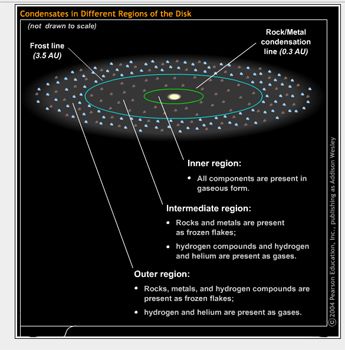
*click for larger view*
"I want you all to remind yourself about the formation of a star," he said as his eyes wandered from the board back to the classroom. Older students - ignoring that most of them LOOKED old now - would be more versed in this topic, but younger students should have read about it in their textbook by now. "Stars are formed from the the collapse of a big cloud of gas, the Sun being no different. So it is fascinating to see how objects that formed from the that very same cloud of gas have different compositions. I want you all to refer to this diagram as I speak, it can also be found on page 34 of your textbooks if you are having a hard time seeing. Now, after the solar nebula collapsed to form our Sun, a disk of material formed around the new star that would become the building blocks for planets. This disk is referred to as the protoplanetary disk, a term I would like you to remember, and its temperature varied across it. Since different materials condense at different temperatures, as many of you mentioned, our solar system formed different types of planets. The dividing line for the different planets in our solar system is called the frost line, as Miss Fischer pointed out." He paused to point his wand at the line on the chart. "As you can see, the heavier rocky and metallic materials are better suited to condense at higher temperatures, and therefore we see solid bits of rock orbiting around the Sun at the same speed. This is in the initial stages of formation mind you. We all know now that the planets have varying orbiting speeds. These bits would stick together more often than they destroy each other and, through a process called accretion, grew larger until gravity forced them into a spherical shape."
He paused and gave his wand yet another flick towards the board to make another diagram appear.
TERRESTIAL PLANETARY FORMATION

" This is the process that, in theory, you all did with your laboratory homework with creating your own solar systems." In THEORY since their planets all just sort of popped into existence thanks to magic. Cue another flick towards the board for one last diagram. JOVIAN PLANETARY FORMATION

" While rock and metal are still present beyond the frost line they are outnumbered immensely by hydrogen compounds are able to condense into ices because of the cold temperatures. Therefore, the building blocks to create planets are dominated by formed hydrogen compounds. Their formation is quite similar to its stellar counterpart. Much like the collapse of the solar nebula, these balls of gas can grow large enough to induce gravitational collapse and it is possible that as protoplanets collapsed, they spilled their celestial guts across the solar system and smaller particles in the surrounding disk formed into some of the moons that now orbit the individual outer planets. The proof of this in in the rings that are around all of the outer planets and the fact that each of the outer planets has so many moons." Balls of burning gas versus balls of condensed gas. Interesting, no? He thought it was fascinating, but that may just be him.
" Once the Sun ignited, the formation of the Solar System quickly ended. The new star's intense radiation and solar winds blew away the remaining dust and gas in the cloud so that the Sun and its planets could not grow any larger." And that was that. The creation of the Solar System. TADA!
He was done lecturing now, for those who were wondering.
" Now, your own solar systems are almost complete. I say almost because you have your terrestrial planets created, but you are missing some Jovian ones. You will be repeating the same process you did before, but this time you will be using powdered hydrogen, helium and nitrogen along with a tiny bit of ground up rock," he said as he gave his wand a loud tap against his desk and suddenly students' lab coats - nicely folded, goggles, mortar and pestle, a container of small pebbles, and jars containing the three powdered elements appeared on each students' desk. " Once you have your lab coats and goggles on, please come and get your solar system and bring it back to your desk. You will need two scoops of each of the powdered elements, so add those to your mortar and then grind it all up with a small pebble. Perform Fingere Elementi and then keep your fingers crossed that it doesn't blow up entirely." Cue a small almost devilish grin from the man. " Given that you are working with relatively large quantities of powdered gases, know that your first attempt will most likely result in an explosion but fear not, no one will lose a limb and remember there is no dying in Astronomy. Once your Jovian planet has been formed, you can dropped it into your box and watch it find its own orbit."
Sound good? It did to him.
" Unless there are any questions, you may begin. You have approximately a half hour before we will move on to another activity using our telescopes. These planets should be more colorful and have rings around them if your spell is performed correctly." Small pause...he was forgetting something... think think think think... OH YES! " Make sure you put your chocolate away and do not eat anymore while you are working." OOC:
You should have a minimum of 2 posts for this activity and complete the following steps:- add two scoops of hydrogen, helium and nitrogen to the mortar
- add a small pebble to the mortar
- grind up the above items into a powder
- perform Fingere Elementi again
- TADA! PLANET! ............hopefully
- add your new planet to the box and close the lid
You will have at least 30 hours to complete this activity.
As always, any questions can be directed to me OOC via PM/VM or IC to Professor Flamsteed.
__________________ We broke into a million pieces, and we can't go back.........................................
But now we're seeing all the beauty in the broken glass.....................................

The scars are part of me, darkness and harmony
My voice without the lies, this is what it sounds like |